Search This Blog

What is Deconstruction (MEG - 5 Literary criticism and Theory)


Deconstruction

A reading strategy emerged as an offshoot of Poststructuralism. The literal meaning of the word is if we think that the word ‘construct’ means to put something together, then we can think of ‘deconstructing’ as taking apart that which has been built. The idea of deconstructing a text is the central practice of poststructuralist reading. It means, quite literally, what it suggests: to take the text apart. This should not be confused with the idea of criticizing a text – or destroying it. Rather, it represents a way of analysing the text by breaking it down. Thus, the central concern of deconstructive reading is to discover what is hidden or buried within a text. 


Poststructuralist criticism looks for the obscured or denied meanings within the text. A text carries an alternative meaning, one that can move far beyond the boundaries of thinking eventually explore the new insights in a particular text.


The task of this kind of theoretical approach is to look for these alternative meanings – for the contradictions and inconsistencies within the text. In addition to this, a deconstructive reading can look for the silences in the text – the things that are quit unspoken.


The emphasis of deconstruction largely lies on the playfulness of language and of its inherent instability owes much to the work of the French philosopher Jacques Derrida. Practitioners of this school of analysis refuse to state a clear formula in reading texts, arguing that such a fixed formula for "application goes against the very spirit of  Deconstruction. The emphasis on textuality and its layered openness also induces a sense of never-ending and dizzying (confusing) play of words .


Paradoxes, ambiguities and ambivalences in texts are brought to the surface in this reading, mainly to demonstrate that the text's stated meaning and buried meaning often contradict each other. With attention to etymology, deconstructive readings invoke the multiple meanings of words, and this proves an effective tool to dismantle the text's existing structure. Thus, deconstruction enables a collapse of the idea of a unitary, unified and the definite nature of the text.


Poststructuralism corrected the blindness of structuralism and opened the possibilities of displacing the “centre” during the analysis of a text.


Two terms closely related to deconstruction are diffĂ©rance and the trace. The former, coined by Derrida in an essay of the same name (1982), means both difference and deferral, playing on the two meanings of the word in French. Derrida uses it to suggest that the idea of the relationship between the signifier and signified implied by structuralism is never complete. There is always an element of deferral – of reference to other words and meanings – that causes a disruption of this process.

Différance

(Meaning is produced through difference and deferral)

In a literary text, words never convey a stable or singular meaning. Each word relies on its difference from other words, and its meaning is constantly deferred/ postponed, until we examine more words and more contexts. The result is that a text opens into an endless play of meanings.

Example T.S. Eliot’s The Waste Land

  • The line “April is the cruellest month” defers its meaning:

“April” traditionally symbolizes spring and rebirth. But Eliot associates it with painful awakening and memory.


Likewise, the Derridean idea of the trace, which appears in both Writing and Difference and Of Grammatology, suggests that words are haunted by what they do not mean. This,  is the trace (or track) that readers can uncover and follow to examine the complex, often contradictory, ideas that may be suggested by a text. Influenced by psychoanalysis, such traces may not be intentional but they are not accidental either – they exist, always, as what is present and yet unseen in any use of language.

Trace

(Each word contains the ghost of others, the absent elements that shape it)

In literature, a word or concept is never fully present in itself. It is shaped by the “traces” of what it excludes or has displaced. These traces remain invisible yet active, haunting the text.

Example William Blake’s The Tyger

The poem asks: “Did he who made the Lamb make thee?”

“Tyger” is defined not in isolation, but by the trace of its opposite, the Lamb, associated with innocence, gentleness, and purity.Even when not explicitly mentioned, the Lamb haunts the Tyger as its moral and spiritual counterpart. The concept of divine creation is also haunted by the trace of destruction and terror, suggesting ambiguity in divine intention.


Aporia

(A logical or interpretive impasse; undecidability within the text)

Aporia arises in texts when meaning collapses into paradox or contradiction, making clear interpretation impossible. These are not narrative flaws but moments of productive uncertainty.




 Deconstructive Criticism — Revive Your Work


Important critical concepts of T.S Eliot (MEG 5 - Literary criticism and theory)


Tradition and Historical Sense

In the essay "Tradition and the Individual Talent" Eliot explains his notion of tradition. Tradition is not the blind devotion towards previous generations, neither imitation nor mere repetition. Tradition can be attained through historical sense. Historical sense is a perception that past has a purpose in the present. According to Eliot: "the historical sense involves a perception, not only the pastness of the past, but of its presence [...] this historical sense, which is a sense of the timeless and of the temporal, is what makes a writer traditional." Eliot continues to say that this historical sense of tradition makes a writer conscious of his/her place in history, his contemporaneity. Historical sense helps the writer to become aware of the continuity of literature where he/ she realizes his/her position among others from Homer to his contemporaries, which helps to "form a continuous literary tradition". No poet has an independent meaning or significance of his/her own. The past writers are significant in the present. This comparison is made for the purpose of analysis and it is reciprocal. Past helps us to understand the present and the present throws light on the past. Tradition to Eliot is the classics and other great literature of the past like the metaphysical poetry. This historical sense helps a writer to escape his personality.


Impersonality theory of poetry

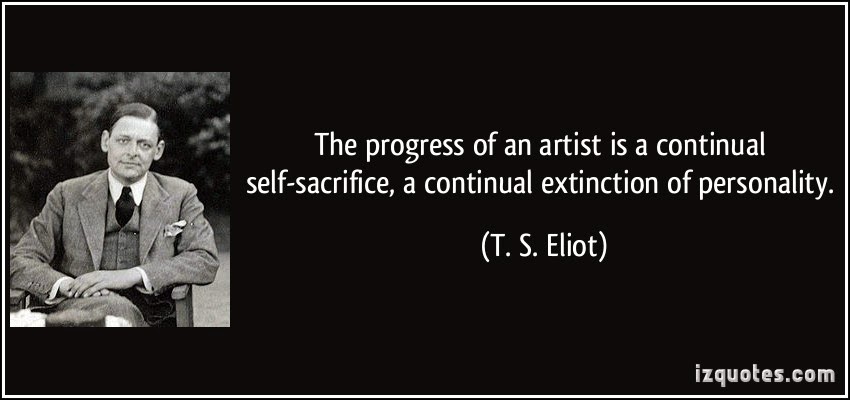
Eliot rejected the romantic theory that poetry is an expression of artist's personality, Poetry is an experience which has a value beyond the poet. "The progress of an artist is a continual self-sacrifice, a continual extinction of personality". asserts Eliot. His impersonal theory of poetry has two aspects. Firstly, all poetry that has ever written is a continuum(a sequence), a living whole, despite the fact they are written by different poets. Second one is the special relationship of a poem to its author. Eliot states in his "Tradition and Individual Talent": "The poet has no personality to express, but a particular medium, which is only a medium and not a personality, in which impressions and experiences combine in peculiar unexpected ways." 

Like an empiricist which he was, Eliot evokes the image of a catalyst in a chemical reaction. According to Eliot, the degree of impersonality in poetic creation will be greater with the greater artists. He states; "the more perfect the artist, the more completely separate in him will be the man who suffers and the mind which creates." This impersonality can be achieved only when the poet acquires a sense of tradition and the historic sense which make him conscious of the present and past.


Objective Correlative 

 
The term first used by American painter Washington Allston in 19century, was revived famously by Eliot in his famous essay on "Hamlet and his Problems" (1919) to designate a concept which later became a major concern of the 20 century literary criticism. According to Eliot, since the poet cannot transfer his emotions or ideas directly to the readers, there should be a mediation to evoke the same. In his own words, "the only way of expressing emotion in the form of art is by finding an 'objective correlative', in our other words, a set of objects, a situation, a chain of events which shall be the formula of that particular emotion." In short, objective correlative is a situation or event designed by the poet which symbolizes or objectifies a particular emotion to evoke the same emotion in the reader. Objective correlative can be called as a medium through which the transaction between author and reader inevitably takes place. The reader responds to the object or medium and through that, to the poem. A famous. exemplification presented by Eliot is from Macbeth. In 'the sleep walking scene', Shakespeare uses the act of unconscious recollection of the horrific crime by Lady Macbeth as a correlative to convey the mental agony to the spectators objectively. A great work of art, according to Eliot, is a set of conceptual symbols or correlatives which attempt to express the emotions of the poet. He also remarks in the essay that Hamlet is an artistic failure as Shakespeare failed to constitute the objective correlative.


Dissociation of Sensibility

It refers to the way in which the intellectual thought was separated from the experience of feeling in the seventeenth century poets like Milton and Dryden.

Eliot put forward the idea of 'dissociation of sensibility in his essay "The Metaphysical Poets"(1921). He makes the idea clear in the following words:

The poets of the seventeenth century, the successors of the dramatists of the sixteenth, possessed a mechanism of sensibility which could devour any kind of experience. They are simple, artificial, difficult, or fantastic, as their predecessors were; no less nor more than Dante, Guido  or Cino. In the seventeenth century a dissociation of sensibility set in, from which we have never recovered, and this dissociation, as is natural, was aggravated by the influence of the two most powerful poets of the century, Milton and Dryden."

Good poetry represents 'unification of sensibility, Eliot insisted. Thoughts are transformed to feelings. Then poetry is transfused by a union of the two which is poetic sensibility. But when the poet is unable to convert his thoughts to feelings, the result is 'dissociation of sensibility, the split between thoughts and feelings. Eliot says that this happened with the poets of late 17 century like Tennyson and (17 Browning. They think, but they could not feel their thoughts "as immediately as the odour of a rose" There is a clear disjuncture between thoughts and feelings. But this was not the case with the metaphysical poets. In them we could witness a unification of thought and experience Eliot compares the metaphysical poets like Donne, Marvell and Cowley with later poets like Gray, Goldsmith and Johnson and found that the former group of poets possesses finer sensibility. 

42 Stupendous T. S. Eliot Quotes - MagicalQuote

Tradition and the Individual Talent by T.S Eliot summary and analysis


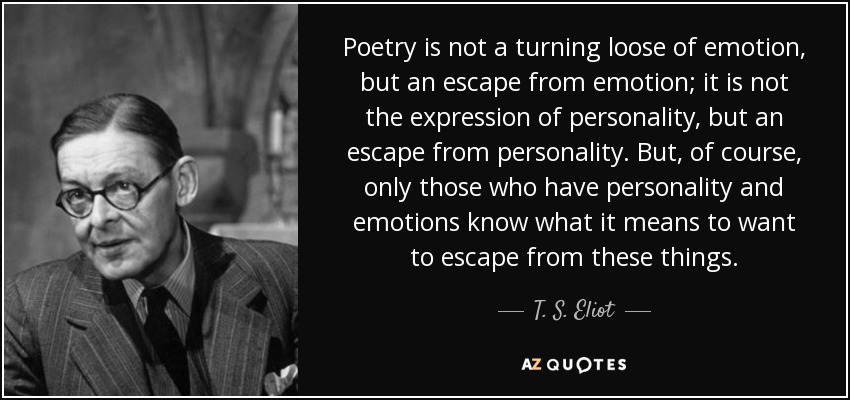
"Poetry is not a turning loose of emotion, but an escape from emotion; it is not the expression of personality, but an escape from personality." – T.S Eliot


“Tradition and the Individual Talent" was published in The Egoist (1919), is a milestone in the field of literary criticism in the twentieth century.  Some of his critical pronouncements contained in this essay have far-reaching consequences for the critics of the twentieth century particularly for the New Critics of USA in the 1940s. This essay has many dimensions. First of all, it attacks the Romantic Criticism of the nineteenth century (particularly Wordsworth's theory of poetry), secondly, it underlines the importance of tradition and examines the correlation between 'tradition' and 'the Individual Talent' and finally, it anticipates the death of the author and announces the focus shift from the author to the text.


In the first part of the essay Eliot defines tradition and examines the relationship of any poem by any poet to other poems by other poets which form the poetic tradition. Because no poem or no poet is an island. Tradition largely influences every budding poet.


The essay "Tradition and the Individual Talent" can be considered as the forerunner of New Criticism. Eliot's concept of tradition' is central to all his critical writings. By tradition, he does not mean, the mere adherence to the past, it does not stand for the continuance of old beliefs and dogmas.


Eliot alerts the readers against taking tradition as a mere imitation and adaptation of the ways of our immediate predecessors. It should be discouraged. Tradition must be acquired by those poets who wish to continue as poets after the first effervescence of adolescence and youth is over. Here, tradition cannot be inherited, it has to be obtained with great labour. Eliot outlines his concept of 'tradition' in the following words:

"It involves in the first place, the historical sense [...] and the historical sense involves a perception, not only of the pastness of the past, but of its presence; the historical sense compels a man to write not merely with his own generation in his bones, but with a feeling that the whole of the literature of Europe from Homer and within it the whole of the literature of his own country has a simultaneous existence and composes a simultaneous order. This historical sense, which is a sense of the timeless as well as of the temporal (universal) , is what makes a writer traditional".

 
This historical sense,' is the awareness of the best fruits of the past and the consciousness of a common unity and continuity of culture, will only help in the growth of a literary tradition.


Like destiny in classical tragedy, Eliot's tradition determines the course of the individual talent. Tradition is not only much more valuable but also much more powerful and pervasive than the individual talent. The individuality of the poet is derived from tradition and after he has completed his task he gets absorbed into it.  literary tradition depersonalizes an individual poet.


The historic sense enables us to see a poem not as an isolated and self-contained instance of poetry, but as a link with similar poems by old poets and as such the culmination of poetic idea or feeling which has persisted through a poetic tradition.

In fact Eliot's concept of tradition functions like a system in structuralism. The system exists independently of the individual author. But no author, no text will convey its full meaning in isolation from tradition. No poet, no artist has his complete meaning alone. His significance, his appreciation is the appreciation of the relation to the dead poets and artists. The poet has his roots in the literary tradition, just as every text carries with it its underlying system. When Eliot writes that "the poet has not a personality to express, but a particular medium which is only a medium and not a personality, in which impression and experiences combine in peculiar and unexpected ways," the medium is the mind of the individual poet which is replica of the literary tradition, "the mind of Europe." so the literary tradition finds in the individual mind a medium for its expression. Thus, it is tradition which write poetry, not the poet and therefore a writer has only a medium to express not a personality.


The relation between tradition and the individual talent is bilateral relationship. If tradition influences the individual poet, the individual poet too influences the tradition and the past acquires an ever new meaning because of the contribution made to it by the new poets. As Eliot rightly says that the past influences the present, as much as the present also influences the past.

 
The second section of the essay begins with an important statement, "Honest criticism and sensitive appreciation are directed not upon the poet but upon the poetry." This marks a clear departure from biographical criticism, and the beginning of 'textual or practical criticism. The emphasis has shifted from the author to the text. After making this significant statement (as quoted above) Eliot goes on to explain his impersonality theory of poetry and examine the relationship between the poem and the poet.


Eliot maintains that a poem or a work of art, is an autonomous entity. He seeks to distance the poet from the poem by saying that
to create a good poem, one should surrender the self. This self sacrifice of personality gives birth to a good poem. One should negate his mind. In doing so one loses his individuality and his personality. All the personal emotions, feelings and experiences should be sacrificed. There should not reflect the personal image of poet in his poetry. Poetry should be completely  impersonal. But it does not mean that the poet should not write his personal feelings, but there personal feelings should be converted in to art’s feelings. Therefore, we as a critic should not look for personality of poet in his poem because the text is objective. The theory that the poet should surrender his personality is depersonalization. The poet’s personal feelings and emotions should be depersonalized. The act of composing poetry must be  impersonal and objective like a scientist.


The progress of the artist is a continual self-sacrifice a continual extinction of personality is the individual talent.

To make the concept of depersonalization clear, Eliot brings analogy of creating sulphuroic acid.


Sulpher dioxide (Feeling) + oxygen (Emotion) + platinum (Mind of Poet) = Sulphurous Acid (Poem) (No trace of Poet’s Personality)


As the platinum itself remains unaffected, the mind of the poet remains unaffected also. Poet's personality is just an agent or medium to active the relation between emotion and feelings. So, the poet is never a creator, but like catalyst (Poetry is organization rather than inspiration).


Towards the end of Section II of the essay, Eliot attacks  Wordsworth's theory of poetry by saying that "emotion recollected in tranquillity is an inexact formula." Instead he suggests that, "Poetry is not a turning loose of emotion, but an escape from emotion; it is not the expression of personality, but an escape from personality."


In the concluding section (i.e., Section III) of the essay Eliot says that the poet must escape from his personal emotion and take that emotion 'which has its life in the poem' only then, he can achieve impersonality in his art, As far as he is concerned the  emotion of art is impersonal.


The most significant utterance in this section is as follows: “To divert interest from the poet to the poetry is a laudable aim”.  This lays the foundation of New Criticism and makes Eliot the forerunner of the New Critics of USA in the 1940s.


 TOP 25 INDIVIDUAL TALENT QUOTES | A-Z QuotesT.S. Eliot -Thinking Activity