Deconstruction as a critical outlook concerned with the relationship between text and meaning was inaugurated by Jacque Derrida’s 1967 work Of Grammatology. It is being put to use in humanities and social sciences such as literary criticism. Deconstruction generally tries to demonstrate contradictions and oppositions and to show that any text contains severe contradictory meanings and therefore has more than one interpretation. As a method of textual analysis, deconstruction involves close reading of works of different types to reveal incompatibilities between the explicit and implicit planes of discourse and limitless interpretation of meaning in a text.
Deconstructive readers look at the ways a text says something different from what it intends
to mean or the ways texts don’t always
mean what they say. In fact, deconstructive readers like to read against the grain. One way to achieve this aim
is to discover conventions and
prejudices prescribing meaning to words.
After recognizing existence of binary
oppositions that restrict meaning, assuming a fixed interpretation, one can explore the text outside assumptions. In a binary opposition one element is superior and privileged while
another element is inferior or
unprivileged and their effects govern interpretation of a text. By reversing the hierarchy and creating new
binary inversions we can analyze various
levels of meaning that evolve when binaries
are reversed.
Samuel Beckett has hailed as a great playwright of the Absurd Theater, a theatrical genre identified by dramatic critic Martin Esslin. Early Absurdist playwrights were categorized by Esslin because of their use of narrative and character in order to expose the meaningless existence in the postmodern world. In his book the Theatre of the Absurd, Esslin states:
“'Absurd' originally means 'out of harmony', in a musical context. Hence its dictionary definition: 'out of harmony with reason or propriety; incongruous, unreasonable, illogical'[...] In an essay on Kafka, Ionesco defined his understanding of the term as follows: 'Absurd is that which is devoid of purpose... Cut off from his religious, metaphysical, and transcendental roots, man is lost; all his actions become senseless, absurd, useless” (Esslin 1973, p.5).
Esslin employed Beckett as his first example, an Absurdist reading of Waiting for Godot has already been well explored by scholars and practitioners. Another popular reading is deeply rooted in the existential struggle of humanity after World War II. A deconstruction of this play offers the potential to explore Beckett beyond the existential and Absurdist readings that critics and audiences typically use to understand Beckettian plays.
Waiting for Godot portrays the events of two consecutive days in the life of Beckett's non-heroes Estragon and Vladimir. As they wait for the Mysterious and ambiguous Godot to arrive, they pass the time by debating about whether to commit suicide. While they wait, the two friends occupy themselves with mundane tasks such as taking on and off a pair of boots; taking off a hat, adjusting it and then putting it back on again; and arguing about eating vegetables. On both days, they encounter a master Pozzo who drives his slave Lucky about the stage with a rope around his neck. On the second day, Pozzo has gone blind and needs Lucky to lead him around the stage. Each day ends with a young boy sent as a messenger to say that Godot is not going to come.
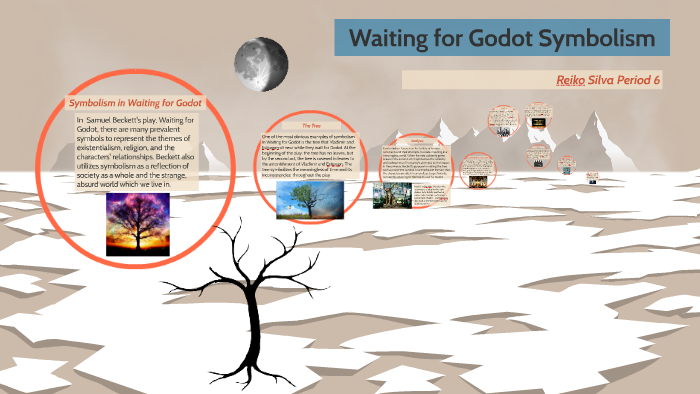
Derridean deconstruction emphasizes the intentional separation between object and meaning—the signifier and the signified meaning of the object. This process can transform a simple concept like the tree in to something more metaphorical than its everyday meaning. Simultaneously, the tree means life, signified by the hope of spring suggested from the growth of the leaves, and means death, signified by the characters’ suicidal thoughts. Thus, in the case of any symbolism there is endless postponement of meaning, which is known as differance in derridian terminology.
As Derrida points in his much celebrated essay ‘The structure sign and play in the discourse of human science’ – the centre is outside the structure. As the play revolves around the enigmatic character Godot and he never appears in the play.
More hints:
Waiting for Godot has been the subject of numerous interpretations and analyses
involves challenging traditional notions of binary oppositions, hierarchies, and fixed meanings.
Deconstruction questions the stability of language and meaning. In Waiting for Godot, the characters engage in repetitive and circular dialogues, often leading to ambiguity and uncertainty. The play challenges the conventional understanding of communication by highlighting the instability of language.
The central theme of waiting for someone who never arrives (Godot) emphasizes the interplay between absence and presence
Deconstruction often challenges fixed notions of identity. In Godot, the characters Vladimir and Estragon struggle with their identities (didi and gogo), and their roles seem interchangeable. The play deconstructs traditional notions of stable, fixed identities, suggesting that identity is elusive and fragmented.
Waiting for Godot disrupts the linear concept of time, as the characters repeat the same actions and conversations
Deconstruction involves challenging established norms and conventions. Waiting for Godot challenges traditional theatrical structures and expectations. The lack of a clear plot, resolution, or definitive meaning subverts traditional dramatic conventions, inviting the audience to question established norms in theater.
The play's open-ended conclusion and the constant waiting for Godot can be seen as an example of infinite deferral. Deconstruction would analyze how this deferral challenges traditional narrative structures and expectations, emphasizing the absence of a fixed, conclusive meaning.