Search This Blog

The Waste Land by T.S Eliot Summary and analysis


Epigraph:

“Nam Sibyllam quidem Cumis ego ipse oculis meis vidi
in ampulla pendere, et cum illi pueri dicerent: Σίβνλλα τί ϴέλεις; respondebat illa: άπο ϴανεΐν ϴέλω.” – From the Satyricon by Gaius Petronius


(I saw with my own eyes the Sibyl at Cumae hanging in a cage, and when the boys said to her: “Sibyl, what do you want?” she answered: “I want to die.”)


The Sibyl of Cumae was a prophetess in service to Apollo and a great beauty. Apollo wished to take her as his lover and offered her anything she desired. She asked to live for as many years as there were grains in a handful of dust. Apollo granted her wish, but still she refused to become his lover. In time, the sibyl came to regret her boon as she grew old but did not die. She lived for hundreds of years, each year becoming smaller and frailer, Apollo having given her long life but not eternal youth.


The Waste Land presents itself immediately as a difficult poem, blocking entrance with an epigraph in Latin and Greek followed by a dedication in Italian. The dedication to Pound, calls him “the better craftsman.” The epigram, from the Satyricon of Petronius, alludes to the Cumaean Sibyl, the seer who was granted a wish by Apollo and asked for immortality. She neglected to ask for eternal youth. Her immortality thus became a process of continual increased debilitation, and her wish became a longing to die. Her condition reflects the condition of the civilization Eliot leads the reader through in The Waste Land, a culture of living death.


The first line, “April is the cruellest month,” takes hold of the reader’s attention. It is a simple and a baffling assertion. It indicates an implicit or rather contradictory reference to the famous Chaucerian glorification of April with its sweet showers at the beginning of The Canterbury Tales.


“April is the cruellest month” the poet asserts because, he explains by an image, it breeds lilacs out of the dead land; it brings life. Poet’s  suggestion is  that it would be better to allow death to be final. But April undoes death by reinstating life. What then is there about life that should make it undesirable? The answer is that the process of revivification mixes memory and desire. It causes the past and the future to clash with each other. This juxtaposition has the effect of provoking longing. It stirs dull roots with spring rain. Paradoxically, “Winter kept us warm” because it covers “Earth in forgetful snow” and feeds “A little life with dried tubers.” It seems that winter is as close as one can get to death while still alive.


The first a few lines of the poem force to think about some actions “Breeding,” “mixing,” and “stirring,” all such processes are disturbing  for modern people.


The scene glides into Starnbergersee (a lake near Munich, west Germany).  The transition is smoothed by the continuing reference to the characteristics of the seasons.


"Summer surprised us, coming over the Starnbergersee

With a shower of rain; we stopped in the colonnade,

And went on in sunlight, into the Hofgarten,

And drank coffee, and talked for an hour."


These lines contain thoughts of Tiresias, the spokesman of the poem, who is a representative of the modern world. Tiresias and his girl friend Marie were travelling in Germany, when they were overtaken by summer They took shelter under the rows of the trees and thereafter walked in the sun-shine the Hof-garten, where they gossiped for an hour. says: "I am not Russian at all; I come Lithuania; I am a German." When Marie was a child, she stayed with her cousin, the Arch-duke. He took her out on a sledge and she was much frightened.


He asked her to hold the sledge tightly and they travelled down together They felt quite free when they wandered into the mountains. Now, she spends her time reading till late in the night. During winter, she goes to the south to enjoy her holidays.


Taken literally, this fragment of a conversation Eliot actually had with Countess Marie Larisch, niece of the Austro-Hungarian Dukes.  The assassination of archduke Franz Ferdinand leads to the sudden outbreak of first world war.

She becomes too nostalgic as we know nostalgia is a denial of painful present.


Eliot now presents another scene in The Waste Land of the modern civilization. The old civilization with its values and conventions is dead and gone, leaving only a heap of broken images. Nothing seems to grow out of its stony waste land. There is an old tree lying on the ground. It represents the good individual who once functioned like a shady tree and proved beneficial to others, but is no more. The barren land is full of crickets but their music gives no satisfaction. The stony wilderness is symbolic of the spiritual barrenness. An angelic voice tells the protagonist to stand under the great rock (the Christian church) which represents God's strength. The shadow of the rock is unchanging. It is an embodiment of eternity. The shadows of the mortals. however, keep changing. The shadow falls behind the man in his youth as his career opens out in front. But with the passage of time the shadow falls in front of him, in the evening of life. This shows that man is essentially a heap of dust. The fear of death keeps man under great tension. It is only pure love which rids man of fear. The godless man is always in the grip of fear. The poet gives an example of fear in love or the pangs of unrequitted love (one sided love). He refers to the story of Tristan who had a guilty passion for Isolde. This guilty love proved fatal. The song in the poem refers to Tristan, who mortally wounded, awaits the arrival of his beloved. He is punished by king Mark, to whom Isolde was to be married. Tristan inquires of the watchman if the ship is bringing his beloved. The reply of the watchman is negative: "Empty and desolate is the sea" sums up the despair and the grief of the guilty lover.

Frisch weht der Wind
Der Heimat zu,
Mein Irisch Kind
Wo weilest du?

 "The wind blows fresh
 To the Homeland
My Irish Girl
Where are you lingering?"
  ~Tristan und Isolde, i, verses 5-8


The poet then gives the story of the Hyacinth girl. This is the first experience of a young lover. The lover is terribly excited. Like the love of Tristan, the love of this young man is also a guilty love as he makes love to the girl secretly in the garden. This sort of love is not free from fear and anxiety. The feeling of the lover is summed up in the line: "I was neither living nor dead and I knew nothing." so love offers no joy or relaxation under the conditions of modern life. Eliot is essentially Puritan and he condemns the laxity in sexual relationship, so common in the modern age.

Oed’ und leer das Meer.

Empty and desolate is the sea. [V. Tristan und Isolde,] III, verse 24. By Richard Wagner

 The Waste Land: The Original 1922 Edition: Eliot, T. S.: 9781947844353:  Amazon.com: Books

Significance of the title The gift of the magi

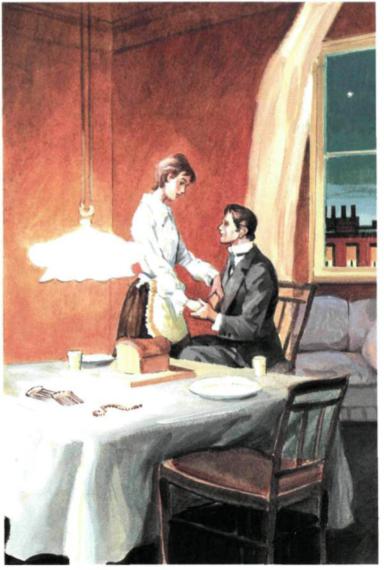
 "The Gift of the Magi" narrates the story of a young couple who sacrificed their most valuable things in order to give each other the best Christmas present. As the title itself hints, there is a deep Christian mythical connection to this short story.  According to Christian tradition The Magi or the three Kings (they also addressed as three wise men in different Mythologies) invented the practice of giving presents on the occasion of Christmas. 

As Bible remarks , the magi were the trio of kings who traveled to Bethlehem from somewhere in the far distance of east (probably Persia) to deliver three presents to the baby Jesus. Their journey itself was an act of sacrifice as they faced several hardships. To travel long in those days was very much difficult.  Thus, they were ready to sacrifice their royal life.

According to the story, the magi were wise folks. The gifts the magi gave to Jesus must have been wise too. This same idea reflects in the short story "The Gift of the Magi" at the end.
 

O. Henry conveys the idea that, they were in fact wise because they had each sacrificed their most valuable possessions for the person they loved most . They were

like the three wise men — the Magi—who brought presents for Jesus Christ after he was born.  this is why Christians still give presents on the occasion of Christmas to remember the gifts the Magi brought to little Christ on that very first Christmas.


Major themes

Sacrifice
Della and Jim give up the most valuable possessions so they can buy Christmas gifts for each other. They proved that their bond is that much intense and unshakeable.  A gift shall be the most valuable thing when someone sacrifice their own precious thing.


The concept of Beauty
Della is worried that Jim won't think she is beautiful with short hair, but Jim loves her far more than just her beautiful hair and how she looks. The physical beauty doesn't contribute anything to their happy life. It's all about the union of soul. In fact Jim and Della share a single soul separated by two bodies.

Family bond
Jim and Della are husband and wife and they love and admire each other. Jim's watch was his ancestral possession and consider as a great pride for him. Still, he sacrifices it to express to indicate his depth of love so that he can make his family strong.

Wisdom
Della and Jim were wise because they were willing to make sacrifices to show their love for each other. Their decision was very much wise as far as the writer is concerned.

Love
Jim and Della are the epitome of love. Their love is very firm in the sense that nothing can shackle it like financial condition or the physical beauty. Economically they were poor but emotionally they are rich. Love made them rich and happy.

OHenry_Level_1

House Made of Dawn by N. Scott Momaday : Summary


The Longhair

In 1945, Abel's grandfather, Francisco, rides his horse-drawn wagon into town and picks up Abel from the bus station. The young man is returning from his service in the army during World War II. So drunk that he does not recognize his own grandfather, Abel slips off the bus and into his grandfather's wagon.

Waking the next day at Francisco's house, he recalls frightening images from his early life and wartime experiences.

The story shifts to Father Olguin, the Catholic missionary assigned to the reservation at Walatowa. He is visited by Angela St. John, a pregnant white woman from Los Angeles. She asks Father Olguin to recommend a local person looking for work who can chop wood for her. A few days later, Abel comes to her house. He chops the wood, but does not talk to her.

At the feast of Santiago, Abel participates in a competition that is based on a folk story about Santiago, who founded the town by sacrificing a rooster. The townspeople believe that the discarded feathers and blood of the rooster produced plants and animals from the ground. At the feast, contestants ride horses toward a rooster that is buried up to its neck in the ground, trying to reach down and pull it out. Abel does poorly at the competition. The winner is an albino on a black horse, who takes the rooster over to Abel and beats him with it.

A few days later, Abel walks to Angela St. John's house. She invites him in, gives him coffee, and asks if he would like to make love to her. He accepts, and the two become lovers. Father Olguin comes to talk to her about her sin a few days later, but she does not regret her actions.

After a festival in town, Abel sits in a bar and has a few drinks expecting albino to arrive. In the climactic moment of the first chapter, when Abel kills albino, who has previously taunted him at the feast of Santiago What they say
to each other is never revealed, we only know that Abel stabs albino and dies emotionless. Later he is sent to prison in Los Angeles.


The Priest of the Sun

Seven years later, the story shifts to Los Angeles. Reverend John Big Bluff Tosamah, the pastor of the Holiness Pan-Indian Rescue Mission known as the Priest of the Sun, preaches to Native Americans in the city. Tosamah is a Kiowa (north America near to Mexico and oklahoma), and he recalls stories told him by his grandmother. He passes these Indian stories along to those in his congregation, many of whom are from other native groups.

Abel has served his jail time for the murder of the albino. He is trying to start a new life in Los Angeles. Abel has a close friend, Benally, who is an Indian; Abel also has a girlfriend named Milly, who is the social worker assigned to his case. He struggles to stay out of trouble and survive in a white man's world.


The Night Chanter

Benally clarifies some of the details of Abel's life in Los Angeles. He is familiar with many of the members in the Native American community and mentions their names in the process of telling the story. He remembers that after his release from prison, Abel was brought to the factory where Benally worked. Benally gave him a place to live and went out to bars and to the beach with him.

One night they are stopped by Martinez, a local police officer. When Abel does not respond appropriately, Martinez hits his hands with his nightstick. He got seriously injured, soon he stops going to work, and spends his days drinking and wandering the streets.

He loses a succession of jobs, and eventually is attacked and beaten up on the street.

Benally contacts Angela St. John. She visits Abel in the hospital. Benally puts Abel on a bus back to the reservation.


The Dawn Runner

When he returns to the reservation, Abel discovers that his grandfather is dying. Abel listens to him murmuring in his delirium for six days about a bear hunt from his youth. The old man dies on the seventh morning.

Abel wakes Father Olguin before dawn and makes arrangements for the old man's funeral service. He takes off down the road south of town. When he spots the figures of men running, he strips off his shirt and runs after them.


Characters Analysis


Abel

The protagonist of the story, Abel is a Native American war veteran who struggles to find his space in the world. The story begins when Abel returns to the Walatowa reservation on a bus, so drunk that he can hardly stand or recognize where he is. Shortly after his return, Abel is hired by Angela St. John to chop wood. The two quickly start an affair. After being humiliated in a festival competition, Abel drinks in a bar with his chief rival, the albino. As they leave the bar, the albino takes a step toward him and Abel stabs him.

After spending seven years in jail for the murder, Abel moves to Los Angles. He takes a job at a factory and meets Benally, who becomes his friend. He also becomes romantically involved with Milly, the white social worker assigned to his case. Much of the story told in Los Angeles is interspersed with sights of Abel wandering around, severely injured from a beating, with his thumbs broken it does not explicitly say what happened (fragmentation).

In the end, Abel leaves the city and returns to the reservation. A week after his return, Francisco dies. After arranging his funeral, Abel goes running to the point of exhaustion.


 Albino

The albino (also called The White Man) is a mysterious but important person in this story. He is frequently called "the white man." At the feast of Santiago, the albino beats Abel in a competition, humiliating him. A week later, Abel drinks with the albino in a bar. They leave together, and Abel hallucinates that the man is turns into a snake. He takes out his knife and stabs the albino to death.


Ben Benally

Benally is a Native American man and a good friend to Abel. Raised on a reservation, Benally adapts the life in Los Angeles and appreciates the benefits of urban culture. He is sympathetic to the way life is on the reservation, but he also recognized the benefits of assimilation: "You know, you have to change. That's the only way you can live in a place like this. You have to forget about the way it was, how you grew up and all."


Francisco

Francisco is Abel's grandfather. A believer in the traditional ways, he is described as a "longhair." The novel opens with him trying to capture a sparrow so that he might have its feathers to use for ceremonial purposes. An elderly man, Francisco is mentioned in an old journal, written by Fray Nicholas. In the 1940s, when the novel begins, Francisco is a farmer working on the communal land owned by the reservation. Francisco was instrumental in raising Abel, and has been his only relative since his mother died when he was five. As such, he holds an important place in Abel's life and acts as a role model for the confused young man.


Martinez

Martinez is the brutal, sadistic police officer who traps Abel and Benally. He cracks his finger with his nightstick. It is that senseless and brutal act that alienates Abel from white civilization. 


Milly

A white social worker, Milly becomes Abel's girlfriend. Eventually, he drives her away with abusive behavior.


Father Olguin

Father Olguin is the Roman Catholic priest at the mission at Walatowa. He is a confused man, torn between the traditions of his religion and those of the society around him. He lives with a physical handicap as a result of a childhood illness.

Because of his unique position, Father Olguin functions as an intermediary between the outside culture and the people of the reservation. When Angela St. John arrives at Walatowa, she asks Father Olguin to help her hire an Indian worker.

A large part of the book is devoted to the pages that Father Olguin reads out of the diary of Fray Nicholas, a priest who was at the reservation in the 1870s. At the end of the novel, when Abel comes to him at dawn to arrange the funeral of his grandfather, Father Olguin does not hesitate to accept the responsibility, but he is disturbed that he has been waken up so early. 


Angela St. John

Angela is the white woman who comes to the reservation and ends up having an affair with Abel. Although she is pregnant, her husband never visits her at the reservation. Seven years after their affair, Abel sees her walk by on the street in California and tells Benally about her. After Abel is beaten and hospitalized, Benally contacts Angela, and she goes to visit him in the hospital. She explains that she has raised her son with an awareness of Indian culture, telling him a story about a bear and a maiden that resembles the story that runs through Francisco's mind as he is dying.


John Big Bluff Tosamah

A pastor of the Los Angeles Holiness known as the Priest of the Sun, Tosamah gives sermons on both Biblical stories and Indian folklore, often mixing the two. Like N. Scott Momaday, he is a Kiowa.

Tosamah has a vast knowledge of Indian folklore and Biblical stories, but he was raised in the city; therefore, his knowledge of the Indian ways is mostly theoretical. Tosamah expresses scornful admiration for the ways in which white society has controlled and obliterated the Indian.


 House Made of Dawn (1972) - IMDb


The Catcher in the Rye by J. D. Salinger : Summary


The Catcher in the Rye begins when Holden Caulfield describes events that happened before Christmas. He was expelled from school, Holden spends his last Saturday on campus enduring a scolding from a teacher and interacting with fellow students. Holden clashes with his roommate, Stradlater, a senior, over Stradlater's treatment of Jane Gallagher, his girlfriend. Stradlater easily defeats the weaker Holden and gives him a bloody nose.

During the last days before his expulsion, he searches for an appropriate way to conclude his school experience, but he ends up getting so annoyed with his school and schoolmates that he leaves in the middle of the night on the next train to New York City. Arriving home a few days earlier than his parents expect him, he hangs out in the city to delay his arrival.

The first few chapters describe Holden's last days at Pencey Prep School in Agerstown, Pennsylvania. Advertisements portray Pencey as an elite school that grooms boys into sophisticated men, but Holden sees it as a place of nightmare.


The middle section of the novel deals with Holden's adventures in New York City. As soon as he arrives in New York, he looks for something to do, since it is too late to call his friends. He calls Faith Cavendish, a bar dancer recommended by a friend, but she does not want to meet a stranger so late. After a failed attempt to get a date with some girls in the hotel bar, he takes a cab to another bar. When he returns to his hotel, a pimp (brothel keeper) named Maurice sets him up with a prostitute named Sunny, but Holden is too nervous to do anything with her. He pays her and she leaves, but the next day Maurice assaults Holden when he refuses to pay more money, and Sunny steals the money from his wallet.

The next day Holden makes a date with Sally Hayes, whom he had dated in the past, to see a show. While waiting to meet her, he has breakfast with two nuns and buys a blues record for his sister. When he finally meets Sally, they go to a concert and go skating, but they eventually get into a fight and split up. After their fight, Holden meets an old classmate, Carl Luce, at the Wicker Bar, where they have a brief discussion until Holden gets drunk and starts asking inappropriately personal questions and he leaves. 


Holden Returns Home

The last part of the novel describes Holden's return to home. He sneaks into his house late at night in hopes of avoiding his parents. He successfully sneaks into the room where his sister sleeps, but luckily his parents were not there at home. At first, Phoebe is delighted to see Holden, but she gets upset when she realizes that he was expelled from the school again. She asks him the reasons, and he blames it on his terrible school. After listening to Holden's excuses, Phoebe criticizes him for being too pessimistic. Holden tries to deny this by explaining how he likes lots of things, but he was always haunted by a few incident : his dead brother Allie and a kid named James Castle who died at  school, and Phoebe. Later, Holden explains that he cannot imagine himself fitting into any of the roles that society expects him to perform, like growing up to be a lawyer or scientist. Instead, he can only imagine being a catcher in the rye (saves children from danger) who stands at the edge of a large rye field watching over and protecting little kids from danger.

Here, Salinger reveals the yet another face of Holden. However, Holden is not only a failure: he is also a deeply sensitive and compassionate person. After sneaking out of the house, Holden spends the night with his favorite teacher, Mr. Antolini, but he leaves early in the morning.

He finally decides to return home and face his parents. The novel never actually describes what happens next, the ending of the novel is enigmatic. But it suggests that Holden faces the dreadful confrontation with his parents and then later experiences some sort of nervous breakdown. The novel concludes with Holden looking back at all the people he has described and fondly remembering how he likes them despite their annoying and phony (dishonest or fake) qualities.


Holden’s final statement—“Don’t tell anybody anything. If you do, you start missing everybody”.


The Catcher in the Rye - Wikipedia

MEG- 11: American Novel Syllabus

SYLLABUS OUTLINE


(1) The Last of the Mohicans (1826)

 by James Fenimore Cooper


(2) Sister Carrie (1900)

 by Theodore Dreiser


(3) The Great Gatsby (1925)

 by F. Scott Fitzgerald


(3) Light in August (1932)

 by William Faulkner


(4) Black Spring (1936)

 by Henry Miller


(5) The Catcher in the Rye (1951)

 by J. D. Salinger


(6) The Floating Opera (1956)

 by John Barth


(7) House Made of Dawn (1968)

  by N. Scott Momaday


(8) The Color Purple (1982)

 by Alice Walker