Search This Blog

The Rocking-Horse Winner : Question answers ( Litmosphere)

 I. Answer the following in one or two sentences

1     1. What was the anxiety that they felt in the house?

Although they lived in a grand style, still they felt always an anxiety in the house that there was never enough money with them. The father and mother had a small income, but not nearly enough for the social position which they had to keep up.


2      2. What was the unspoken phrase that haunted the house?

The unspoken phrase that haunted the house was : “There must be more money! There must be more money!”. The children could hear it all the time, though nobody said it aloud. They heard it at Christmas, when the expensive and splendid toys filled the nursery.


3      3. What according to the mother causes to have money?

According to the mother ‘luck’ is the primary factor which causes to have money. She says : “ we are poor members of the family, because your father had no luck ”.


4     4. Why is it better to be born lucky than rich?

As far as the mother is concerned luck causes to have money. If somebody is lucky he/she has money. That is why it is better to be born lucky than rich. If somebody is rich they may lose their money. But, if he /she is lucky, they will always get more money.


5    5. What was Paul’s secret of all secrets?

Paul’s secret of all secrets was his wooden horse, which had no name. whenever he rides his rocking horse, it sometimes reveals the name of the horse which is going to win in the big races.

II. Answer the following in a paragraph.

1. How does Paul seek luck?

According to Hester it's luck that causes to have money. and she consider herself is the most unluckiest person as they are poor and her husband too had no luck. 

Hence, Paul wanted to prove that they have enough luck. Paul’s secret of all secrets was his wooden horse, which had no name. whenever he rides his rocking horse, it sometimes reveals the name of the horse which is going to win in the big races. he knew the hours could take him to where there was luck. This rocking horse remarkably made him winner several times.

2. Character sketch of Hester?

Hester is one of the most significant characters in the short story The rocking horse winner. She is the mother of Paul. though she is beautiful and married for love, she consider herself is unlucky and her love later turned to dust.

everybody else said of her that she is such a good mother and she adores her children. Although they lived in a fairly good style, they felt always an anxiety in the house that there was never enough money. She makes a great effort and tried different things to improve their way of life, but could not find anything successful.   

3. "My family has been a gambling family, and you won't know till you grow up how much damage it has done". Explain this statement?

Hester can never support gambling, as it had done irrecoverable damage to their family. Paul wanted to prove that they have enough luck. The only possible way is horse betting or gambling. Paul keeps everything as secret, he even seeks the help and support of their family lawyer in order to give the money that Paul earned through gambling. 

"My family has been a gambling family, and you won't know till you grow up how much damage it has done" this statement clearly marks that why she prohibits gambling. As it had destroyed her family once.

4. Paul's final bet?

As Derby race approaches, Paul grows more tense and his mother becomes anxious about him. Two nights before the Derby, she is at a big party in town and becomes overwhelmed with worry about Paul.

Paul's mother and father return from the party at about 2 a.m. Again caught with extreme anxiety, Paul's mother goes upstairs to check on Paul. She listens outside his door and hears a strange heavy noise that goes on and on. She can't identify the sound. She opens the door, switches on the light, and is frozen in fear and anxiety at the sight. Paul, in his green pajamas, is rocking wildly on his horse. When she cries out to him, he screams, "It's Malabar!" and then falls from the horse. Paul's mother rushes to hold him.

For three days Paul suffers from a brain fever and his mother stays by his side, heartbroken. Paul's mother asks everyone what Paul means by "Malabar." Uncle Oscar says it is the name of a horse running for the Derby, and then he speaks to Bassett and places a bet on Malabar.

On the evening of the third day, Paul dies. Bassett asks to speak to Paul. He whispers to Paul that Malabar won and Paul won over £80,000. Paul tells his mother about his rocking horse and how lucky he is. He dies that night. Uncle Oscar comforts his mother by telling him that she is now much richer.

4. Supernatural element in '' The Rocking Horse Winner''?

D.H Lawrence is the most celebrated modern writer and his craftsmanship reflects in the short story The Rocking Horse Winner. He significantly uses the supernatural elements such as the murmuring house and the rocking horse. 

When Hester in general and Paul in particular conscious about their financial state, their house seems to whisper the phrase "There must be more money!,There must be more money!

Then, as the title itself remarks. the wooden rocking horse has the magical power as after every ride it can predict the name of the horse racing winner. it's again quite supernatural that a wooden horse easily reveals the name of the winner.

5. Symbolism in ''The Rocking Horse Winner''?

  Through the short story The Rocking Horse Winner D.H Lawrence shows the nature and life style of a modern middle class family. this family is highly materialistic as their main aim is making money and becoming rich.

The whispering house is a powerful symbol as it expresses the general mindset of the characters like Hester and Paul. their house seems to whisper the phrase "There must be more money!,There must be more money!" which reflect the mind of the characters. thus, D.H Lawrence  used surrealism in the short story, it is the manner of representing the unconscious mind of the charters in a distorted way.

Yet, another powerful symbol is the Rocking horse, it acts as the greatest secret as well as the mystery. It symbolizes Paul's luck and fortune. in the final part of the story the same horse leads to the death of Paul.

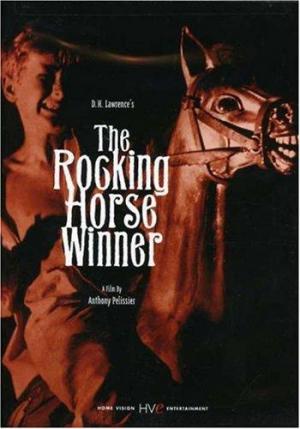
 

   THE ROCKING HORSE WINNER 1949 British Cinema Classic Australian daybill -  Moviemem Original Movie Posters

The Rocking-Horse Winner by D. H. Lawrence summary


The story begins with a description of Hester, the mother of the family (Paul's mother). She is referred to throughout the story as "mother and finally reveals her name." She is beautiful but unlucky. Though she married for love and has three healthy children, her marriage is unhappy because of her financial condition.

“Although they lived well, they were never totally happy in the house. There was never enough money. The mother had a small income, and the father had a small income, but not nearly enough for the social position which they had to keep up.”

The family lives in a pleasant house with a garden and servants. The house is filled with expensive modern toys, like a shining rocking horse. The house is always haunted by some hidden anxiety over a lack of money. Father can’t  constitute enough money to support their lifestyle. Paul's mother has tried various jobs to make more money but failed. The house becomes haunted with the whispered phrase, "There must be more money!"

One day Paul asks his mother why they don't keep a car like Uncle Oscar does. She explains that they are certainly poor because they have no luck. Father is very unlucky in business, and she is unlucky for having married him. But, Paul makes some counter arguments and declares that he is lucky.

Paul realizes the fact that his mother never admits him as he is lucky. Hence, his primary concern turned to prove as he has enough luck and fortune. While his sisters were playing quietly, Paul rides his rocking horse furiously. Paul whips the rocking horse and commands it to take him to the right direction.

Later, Paul's mother and Uncle Oscar come into his room when Paul is in the midst of his wild rides. Paul's mother is anxious but Uncle Oscar encourages him. When Paul finishes the ride, he tells his mother and Uncle Oscar that he got the right path. When Oscar asked about the name of his horse,  he replied that it has different names. Last week, for example, his horse was called Sansovino. Uncle Oscar knows that Sansovino was the name of the horse that won a major annual horse race called the Ascot. Uncle Oscar is a big fan of horse racing and pleased to learn that Paul too had a genuine interest on horse races.

Uncle Oscar decides to talk to Bassett, their young family gardener. Bassett admits that he and Paul discussed the matter regarding betting on horses. Uncle Oscar takes Paul for a drive in his car to learn more. After making Uncle Oscar promise not to tell, Paul reveals him that he and Bassett are partners in betting on horses. Paul gives Bassett money and tells him which horse to bet on. At first, Uncle Oscar thinks it's all a joke until Paul tells him how much money they are betting.

Uncle Oscar takes Paul to the next big horse race and places a bet for both of them on the horse of Paul's choice. The horse Paul chooses comes in first. Uncle Oscar still is doubtful about this mysterious act, but Paul offers to make him a partner.

Uncle Oscar takes Paul and Bassett to an afternoon horse race to talk. Bassett explains that about a year ago, they placed a bet on a horse and lost, but after that their luck turned. Paul says that as long as they're sure which horse to bet on, they win. Uncle Oscar is still not sure about it to believe them and asks to see the money. They drive home and Bassett shows him the cash. Uncle Oscar asks Paul how he knows which horse to bet on, and Paul gives a vague answer with a mysterious smile. Then, Uncle Oscar decides to become their partner.

As the next big horse race is approaching, Paul says he is sure that Lively Spark will win, even though that horse is not favored. The three place their bets, and Lively Spark comes in first. Paul wins £10,000 and Uncle Oscar wins £2,000. Uncle Oscar says this makes him nervous, and he asks Paul what he is going to do with all his money. Paul says he started this for his mother because she and father are unlucky.

Paul says he doesn't want his mother to know that he is lucky because she might try to stop him. So the two make a plan for Paul's mother to receive £5,000 from the family lawyer who will say it came from a relative and is to be paid out £1,000 at a time on her birthday for the next five years.

Paul's mother's birthday comes in November, and the house has been whispering more than ever. Paul's mother had been going into town to work as an artist but is dissatisfied by how little money she made. Paul is anxious to see his mother's reaction when she opens the birthday letter telling her about the money. When she opens the letter at breakfast, Paul's mother's face hardens. Later in the day, Uncle Oscar tells Paul that Paul's mother has asked the lawyer for getting the entire amount at once, and Paul decides she should have it.

Instead of paying off their debts, Paul's mother spends the money on expensive new furnishings and a tutor for Paul. As a result Paul hears the house go mad with screams for more money. In between studying Paul continues to bet on horses, but he isn't always sure of the winner and loses money. By summer Paul is wild-eyed with madness. Uncle Oscar tells him to stop all these playing with horses. Even Paul's mother is anxious about him and tells him she plans to send him to the seashore to rest. Paul tells her desperately that he can't possibly leave before the Derby race. Paul's mother is worried about his obsession with horse racing and tells him gambling has once done irrecoverable damage to her own family.

He tells her that nothing to worry about. Paul knows he has a secret in the house that he hasn't told anyone about, not even Bassett and Uncle Oscar. His secret is that when he rides his rocking horse, it sometimes reveals the name of the horse that will win the next big race.


As Derby race approaches, Paul grows more tense and his mother becomes anxious about him. Two nights before the Derby, she is at a big party in town and becomes overwhelmed with worry about Paul.

Paul's mother and father return from the party at about 2 a.m. Again caught with extreme anxiety, Paul's mother goes upstairs to check on Paul. She listens outside his door and hears a strange heavy noise that goes on and on. She can't identify the sound. She opens the door, switches on the light, and is frozen in fear and anxiety at the sight. Paul, in his green pajamas, is rocking wildly on his horse. When she cries out to him, he screams, "It's Malabar!" and then falls from the horse. Paul's mother rushes to hold him.

For three days Paul suffers from a brain fever and his mother stays by his side, heartbroken. Paul's mother asks everyone what Paul means by "Malabar." Uncle Oscar says it is the name of a horse running for the Derby, and then he speaks to Bassett and places a bet on Malabar.

On the evening of the third day, Paul dies. Bassett asks to speak to Paul. He whispers to Paul that Malabar won and Paul won over £80,000. Paul tells his mother about his rocking horse and how lucky he is. He dies that night. Uncle Oscar comforts his mother by telling him that she is now much richer.

 Question & Answers

 The Rocking Horse Winner (1949) - Filmaffinity


What is Transcendentalism?


Transcendentalism is a literary and philosophical movement in New England in the early and middle part of the 19th century. It gave expression to several strains of thought :


1) the weakening of Calvinistic views about the corruption of human nature;

2) the rise of Romantic attitudes toward the pervasiveness of the divine and the inherent power of the individual imagination;


3) and the frustration with what was seen as the polite and unemotional rationalism of Unitarian thought.


Once considered to have derived from European movements, it is now generally seen as a development of native tendencies.
Centered on Boston and Concord, some of its most notable voices were those of Ralph Waldo Emerson, Henry David Thorean, Walt Whitman, Edgar Allan Poe, Herman Melville, Nathaniel Hawthorne, Margaret Fuller and Bronson Alcott. The
British writers such as William Wordsworth, Samuel Taylor Coleridge and Thomas Carlyle profoundly influenced these writers.


Transcendentalism was opposed to the idea that man needed an intercessor through which to reach the divine, and was critical of formalized religion. Like the physical universe itself, all constructive practical activity, all great literature, all forms
of spiritual awareness were viewed as an expression of the divine spirit. The oft- expressed ambition was to achieve vivid perception of the divine as it operates in common life, an awareness seen as leading at once to personal cultivation and to a sense of history as an at least potentially progressive movement.


1 Explain the meaning of the term 'Transcendentalism' and show its treatment in 19th century American Literature?


Like Puritanism, Transcendentalism also played an important role in the 19th century American literature.
The pioneers of this movement not only enriched American literature but also paved the way for the coming writers. In addition to this, these pioneers broke out the old traditions and established their own distinctive form of literature.


Transcendentalism was a philosophical dissent from Unitarianism, which represented the compromise of rational Deism with Calvinism, relating to the rationalist's acceptance of liberal scientific thought and rejecting extreme concepts concerning the original depravity and the inherited guilt of man. The rising young transcendentalists asserted that the Unitarian creed had become conventional and complacement in its orthodox fidelity to Christian dogmas of supernaturalism. They rejected Locke's materialistic psychology in favour of the
idealism of the German thinker Immanuel Kant who declared that the "transcendental" knowledge in the mind of man was innate. Following the philosophy of Kant, they asserted the doctrine of correspondence between the microcosom of the individual mind and the macrocosom over-soul of the universe,
and they derived an enlarged conception of the sanctity of the individual and his freedom to follow his intuitional knowledge.


The American Transcendentalists were influenced by British writers as Wordsworth, Coleridge and Carlyle; Kant, Hegel, Fichte, Schelling, Goethe, Richter, Harder influenced the transcendentalists with their philosophy; Greek philosophers like Plato, the Sufis, and the writers of the Upanishads and the Bhagavad-Gita, and the Buddhists and the eclectic idealists profoundly influenced the transcendentalists. These transcendentalists used to meet at Emerson's Concord house, and through their magazine The Dial, they published their philosophy. "Book Farm" (1841) and "Fruit Lands" (1842) were agrarian experiments in communal living, supported briefly by the transcendentalists concerned with the social order.

 
'Nature' was the first comprehensive expression of American Transcendentalism. Emerson provided a fresh and lyrical intimation of many of the leading ideas that developed in various essays and poems.   

Thoreau's transcendentalism was empirical, not theological. He did what he felt to be right and publicly opposed what he felt to be wrong. If Emerson believed in Man, Thoreau believed in men. Both were the party of Hope against the party of Memory, and were symbolic of a New England turn from Calvinism through Unitarianism to a belief in man. Both wrote and lived as if the 'American Adam' were more possibility than myth. Walden is his famous book.

Whitman came to transcendentalism by way of his mother's Quakerism, and Carlyle's and Hegel's writings, but Emerson was the immediate influence. The Leaves of Grass was his mommental work. Through his book, he taught the philosophy of democracy. He believed in the transforming power of love in humanity and in life. Whitman was theoretically the answer of Emerson's prayer, as he was also the voice of the land of Promise, the first wholly unique one to emerge from American continent. Nathaniel Hawthorne satirized Book Farm in his novel The Blithedale Romance. The Scarlet Letter was his another novel in which he has bitterly satirized Puritanism. Herman Melville satirized Puritanism in his novel Moby Dick.

 
These transcendentalists – Emerson, Thoreau, Hawthorne, Melville, Whitman – seem to differ from one another more than they agree. First, they are divergent in temperament; second, they are different in their choice of subject matter and literary form; thirdly, they differ in their interest and capacity for sustained philosophical thought. Despite their differences, they have certain common things. These writers have a profound sense of human predicament. They are worried about the problem of man. They all believe that individual virtue and happiness depends upon self realization and the self realization depends upon the harmonious reconciliation of two universal psychological tendencies. The five writers have a common assumption. They think that intuition and imagination offer a surer road to truth than abstract logic or scientific method. Finally, these five writers were able to deduce a consequence of immense practical importance not only for their own work but for the subsequent course of American literature as a whole.

 
To conclude, American literature of 19th century was developed, and enriched by these writers. They are unforgettable for their philosophy. They prepared the way for the coming writers.

         Nature always wears the colors of the spirit.” (Ralph Waldo Emerson) |  developingsuperleaders