- Failure of modern family system in India
- The condition of common family in Post-independent India
- Plight of womanhood in the contemporary world
- Disintegration of modern middle class family
- Representing Social issues and family dynamics
The play Halfway House is divided into three parts: Prologue, Act I and Act II. The Prologue is an important part of the play which gives a general idea about the drama and by setting the tone. Mohan Rakesh’s Halfway House is a play about a family going through difficult times and raises a number of issues relevant to the socio-cultural situation of the time. The Prologue introduces the subject of the play: “a particular family and its particular circumstances”. In the Prologue we meet “the man in a black suit” talking directly to the reader/spectator in the first person and making general observations on life. At this point, the man wearing a black suit is both an actor and a character who talks about the various roles he is going to play in the unfolding drama. In fact, he acts as a central character of the play. He creates a link between the performers, the performance and the audience and for this reason is a figure similar to that of a sutradhar, the introducer of a play in traditional Indian drama. Apart from this role that this actor assumes in the prologue, he also enacts the characters of Mahendranath, Singhania, Jagmohan and Juneja in the text. Indeed it is an innovative method in drama where one man plays four different roles; nevertheless it is not a mere technical point. In fact, Rakesh seems to make a comment here on human nature in that all men essentially are the same behind the different masks they wear.
He encourages the reader/spectator to give their suggestions on the problems
raised in the play. Don’t you think that had the playwright offered a solution to
the problems projected in the play. The playwright consciously leaves characters, complex situations and issues midway/‘halfway’ as it were, without
probing them further. This offers us some clue about the title of the play—Halfway House.
Act One
The act opens with Savitri entering the living room, the place where the entire
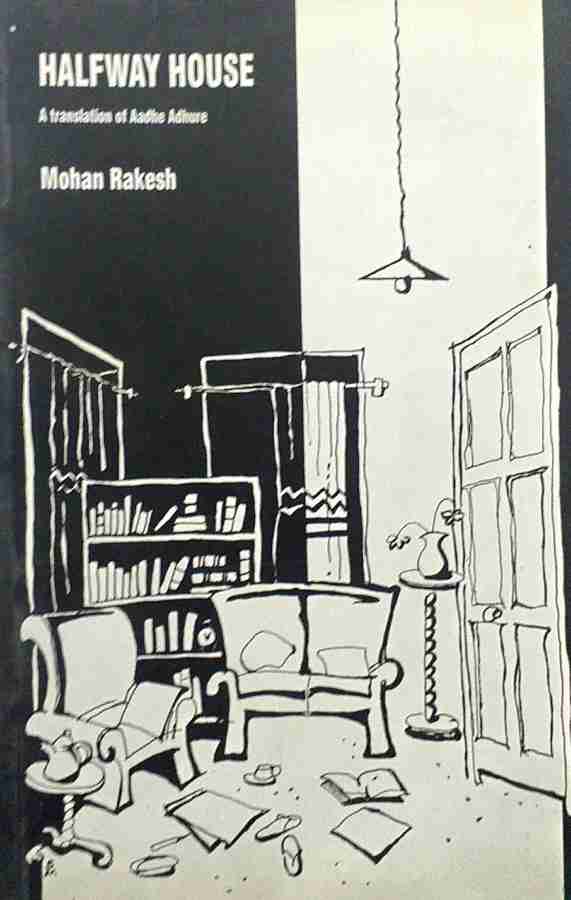
action takes place. The first impression one forms of her character is that she has a sense of self-assurance, confidence and power who knows her position in the house. In comparison, her husband is a beleaguered man surrounded by several problems. The moment Savitri enters the house, she complains the reckless attitude of the household towards her. The setting of the room and the objects lying around tell us something about the characters who belong to the family. The pyjamas of Mahendranath, Ashok’s magazine-clippings, and the torn books of Kinni give us a clear view of these characters. Angry with all of them, Savitri begins clearing the mess. As she has invited her boss Singhania for tea to fix a job for her son Ashok. She was compelled to plan this visit of the boss because of the indolent attitude of her Husband, Mahendranath. He was about to leave the house, because We are told at this point that Mahendranath in the past borrowed money from his friend Juneja and this money has to be paid now.
On his side, Mahendranath hopes that some help can come by associating with Juneja. Savitri, however, does not find Juneja trustworthy nor does she think he would ever be genuinely friendly towards her husband. There was a clear lack of trust between the husband and wife. One can truly call it a kind of disconnect between Savitri and Mahendranath. In one of their many quarrels Mahendranath puts across a relevant question to Savitri: “Have you ever considered why I stay away?” The question remains unanswered as the reader/spectator struggles to find the answer with the hints available in the text.
Meanwhile, another character appears named Binni the older girl in the family who eloped with and married Manoj. Binni regularly visits her parent’s home in a state of tension and unease. Unhappy in marriage, Binni helplessly tells her mother that “before I got married I thought I knew Manoj very well. But now…” she feels that “the longer two people live together, breathe the same air,…the…the more estranged they become from one another”.
We have two concrete instances of marriage, one that of Mahendranath and Savitri, and the other of Binni and Manoj- both of which point towards the failure of the institution itself, in which individuals find themselves becoming more and more alienated from their spouse.
At the same time, there is a kind of mystery created around the house in which
these characters live. Binni tells her parents that her husband feels uneasy in her
parent’s home and that the “air” in the house has made them abnormal people.
That is why Binni keeps coming back to the house to find out the problem. Note that Manoj gets a mention in this conversation but never once appears in person. Here, Mohan Rakesh presents a perspective on the family of Mahendranath through an outsider, Manoj.
We are next introduced to the younger girl in the family Kinni who after having
returned from the school and finding no one in the house runs out in the street to pick and accompany her. She complains of having eaten nothing in school for want of money. Kinni’s state in the house is that of a neglected adolescent who craves for care and affection but gets none from the family. She turns into a rebellious girl with none in the family to confide in. She is bullied by her brother Ashok, too.
One can easily sympathize with her isolated state in the house. Kinni told her mother that she “feels so ashamed wearing torn socks to school” but Savitri evaded the problem. She keeps recounting the ways in which she’s humiliated in class by the teacher for not having brought the skeins of thread to school. In response, she gets scolding and threats. Indeed, Savitri is acutely aware of the problem but lacks sufficient means to meet the needs of the young girl. Savitri feels helpless and once says to her elder daughter: “I can’t manage any longer, Binni. I just can’t …”. The audiences are left to wonder whether Savitri’s family is an isolated case or represents broader social trends in post-Independence India.
However, Ashok, the eldest among the three children of Mahendranath and Savitri, has no desire to take up a job particularly through help from social contacts of his mother. We are told that Ashok hasn’t shaved for days, is wearing old trousers, a worn-out shirt and that he has been sleeping in the house all day long. The image provided to us of Ashok here is that of an idler who scarcely feels responsible about matters relating the family. It is also given that Ashok had quit his college halfway and left in six weeks the job his mother arranged for him. He is disrespectful to his parents, particularly towards his father. Consequently, Mahendranath has a bout of self-pity as he comments: “For how many years have I been bearing the burden of life? And for how many years have I been looking after this family? And despite that, what have I come to…that everyone answers me back, is rude, disrespectful, impertinent…I’m responsible for ruining my life, your (Savitri’s) life, all your lives! And I still stick to this house, because I’m a parasite, because I like depend on my wife”. The issue he has raised in this speech can scarcely be ignored. Irritated, he leaves the house at this moment deciding never to come back. Initially, he goes to his friend Juneja’s place but returns home the next day.
It is not the ideal family that stands united in times of crisis nor are its members sympathetic towards one another. The image of a self-sacrificing mother is constantly denied to Savitri even when she claims it. The values of love, compassion and respect that form the basis of the familial world are constantly done away within the text. The playwright focuses upon a particular section of society, the upper-middle class where notions of family and fellow- feeling are increasingly receding.
Savitri announces that her boss Singhania is about to reach their place. To this, Ashok reacts in the following manner: “If he hadn’t been your boss, I would have booted him out that day. Lolling on the sofa and scratching himself in the groin (private body parts). His thoughts stray in one direction, his eyes in another, and I’m supposed to guess that he’s addressing me”. Ashok’s description is indeed graphic; we actually witness Singhania with his boastful look and pompous style. Singhania’s elitist pro-American approach has its basis in the class he belongs to. Singhania in the play is evidently upset about the way “labour unrest (is) sweeping through the country today” and more particularly the labour problem in his own firm. Although Singhania appears only once in the play, the impact that his personality leaves on the reader/spectator is offensive. Mohan Rakesh makes a scathing attack on this particular section of Singhanias, suggesting that it is almost impossible to sympathise with such a lot. The audience is left to identify with Ashok’s disgust of the man and the turmoil caused by his presence in the house. The act of squashing the insect played out by Ashok is in some sense a reference to what he’d like to do with Singhania who is viewed by Ashok as an insect and a monster alternatively.
THE WOMAN: Don’t, if you can’t but I won’t stand for it. When I go out of my way to invite people, then you make fun of them. Did you hear? I’ll never, never stand for it.
THE BOY: If you can’t stand for it, why do you have to invite people who make…
THE WOMAN: Go on, tell me!
THE BOY: Let’s change the subject. This is why I wanted to leave at the start.
THE WOMAN: Complete your sentence.
THE BOY: …who make us feel even smaller than we actually are.
The argument ends with Savitri’s decision that “from now on I’ll only bother about myself…I have done my utmost. It’s the end now as far as I’m concerned…it really is the end”. there seems to be no end to quarrels and fault-finding among the family members, with Mahendranath and Savitri disagreeing on almost every point that is raised.
Act Two
The second act begins with clear indication of Savitri losing interest in the running of the house; she has not tidied the room on the following day. One expects significant changes to take place in this act with the feeling that things would finally move in a particular direction—perhaps the family would break gradually as each individual leaves the place and opts to live life on one’s own terms.
Binni’s comment is significant: “She (Savitri) was so withdrawn last night…and
this morning…I’ve never seen her like this before” the situation sets the mood of expectation that Savitri would change considerably and so would the circumstances. It is evident that Mahendranath has been staying with Juneja all this while and the latter’s visit to their house is in connection with the state of affairs that exist between Savitri and Mahendranath. At the same time, the focus shifts for a while on Binni as she feels like a stranger in her own house.
Meanwhile Savitri has decided to go out for tea with her long-standing friend Jagmohan with whom she has “something important to discuss”. She says to Binni: “When you come next time I may not be here”. It seems that Savitri has finally resolved to move out of the house and give up her role of a wife and mother. The breaking of her necklace at this very moment symbolises the breaking of the family-ties she has held until now. The broken necklace leaves her upset but she goes to the cupboard to wear another one—which in turn suggests that Savitri has chosen another life for herself.
As Savitri looks in the mirror she finds her hair growing grey, her eyes becoming more shadowy and suddenly finds Jagmohan behind looking silently at her from the door. He addresses Savitri—”Hello, Cuckoo”—from which we get an impression that Jagmohan has been an intimate friend of Savitri (here she calls him “Jog”) and that the two have in fact been one-time lovers. This further gets substantiated with Savitri’s commanding tone while speaking to him: “But I told you to come straight here, without wasting a moment”.
In fact , Binni could have avoided marrying Manoj and taken up a job instead, and Ashok too had the choice to earn his livelihood independently. But he would not take up a job that will ruin his self.
As soon as Savitri leaves with Jagmohan, Kinni enters the house crying and on looking “around at the emptiness of the room” runs out. She has been chided by Surekha’s mother who as Kinni tells Binni “says I’m ruining her daughter and other…horrid things about us…”. Surekha’s mother thought that Kinni’s entire family lacked moral values.
The question of domestic violence is another important aspect of India’s social
life. There is a sharp reminder in the text of brutal wife-beating by Mahendranath. Binni in her conversation with Juneja tells him of this: “It’s not a matter to be dismissed that lightly, Uncle! When I lived here it was like being…you can’t even imagine what it was like…Daddy’s rages when he tore Mama’s clothes to shreds…when he gagged her and beat her up behind closed doors…dragging her by the hair to the …(shudders) I can’t even recount the fearful scenes I’ve witnessed in this house!”. Our perception of Mahendranath also undergoes a change as the figure of a meek husband transforms into a ferocious animal. The conflict assumes new proportions as Savitri and Mahendranath are being analysed in their absence by the two close observers—Binni and Juneja. While Binni more or less defends her mother, Juneja is on the side of his friend Mahendranath.
The encounter between Savitri and Juneja turns out to be a bitter one in the text.
Suspicions get established and secrets revealed as each blames the other for the
wrongs done to the family; Juneja accuses Savitri for having Mahendranath “in
a trap” so that “he has become incapable of doing anything for himself” and Savitri tells him that Mahendranath has not proved to be a ‘man’.
Let us also take up the issue that Savitri has raised about Mahendranath: “Ever since I’ve known him, I’ve always found him leaning on someone or other. Particularly on you (Juneja). He’s never been able to do anything without asking you. If we want to buy something, he must ask you. If we want to go somewhere, he must ask you. When he wanted to marry me, he had to ask you. He can’t even breathe without asking you!”. According to Savitri, “the object of his existence is…as if…he were there only to fill in the gaps in the lives of others…whatever other people expect of him…or in whichever way they think they can use him”. Savitri has always been suspicious of Juneja for using Mahendranath and befooling him with regard to the money he owned and invested.
Savitri is bound to meet new people, make new friends and comment on people’s behaviour. She is aware of her unsuccessful marriage and it is only natural that she would imagine a happy life with another man. Juneja is aware of the events that have taken place in Savitri’s life, and sure that Savitri tried to attract Manoj. The latter however, chose the daughter. Binni expresses her state of shock at this revelation, the first impact of which is one of disgust for Savitri.
The play ends with Mahendranath’s return to the house and it becomes clear that nothing is going to change in the life of any of the characters. This is in a way the anti-climax of the play for at the end of Act I and the beginning of Act II we were under the impression that things would change and move in a new direction, taking us perhaps to a new set of problematic. This, however, does not happen. Why? The playwright gave the background of the unchanging nature of circumstance. Certainly, Mohan Rakesh focuses upon the problems faced by the family but is unable to indicate for the benefit of the reader a direction in which answers could be found. The play seems static and the problems insurmountable.