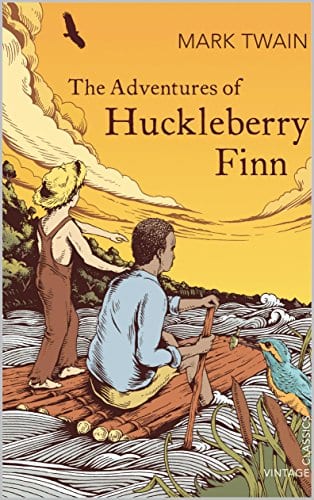
Mark Twain brilliantly utilizes satire, irony and
humor to convey his views on the
follies,
hypocrisies and evils of the society by making fun at religion, education, and
slavery. This satirical viewpoint
of Twain is clear throughout the novel to keep the reader pleasant and make the story more interesting.
The opening events of The Adventures of Huckleberry
Finn are related to the novel that preceded it,
The Adventures of Tom Sawyer. The Adventures of Huckleberry Finn and Tom Sawyer are set on the
Mississippi River. At the end
of The Adventures
of Tom Sawyer, Huck, a thirteen- year- old poor son of a drunken father,
and his childhood friend Tom, who is from a middle class family, found gold, which a robber hid in a hidden cave,
and Huck gained a huge amount of money, they
invested in on the basis of monthly interest.
At the outset of The Adventures of Huckleberry Finn,
Huck is staying with the Widow Douglas,
a woman who adopts Huck in an attempt to
civilize him.
Widow Douglas lives with her sister, Miss Watson, both of whom try to teach
Huck proper manners, but he doesn’t like staying at the Widow’s house. Tom Sawyer convinces him to stay with
the Widow Douglas and Miss Watson so he
would be able to join Tom's gang daily at night.
Huck has been forced to go through many rituals,
while living in the Widow Douglass’ home, like
the meal time prayer, that seemed unimportant to him, which is one of the reasons he is unhappy in her
home, and the Widow fails to
make Huck
civilized. Huck’s description of the widow as an overly-passionate Christian, ridicules the behavior of religious people, but in a
light and humorous style to
show the
ridiculousness of their actions.
The Widow attempts to civilize him by teaching him
Christian values, but he is not interested in
these lessons, for he found that they were completely far away to his life. Thus, Twain here satirizes the widow’s religious position.
Then Twain shows through the novel that Huck is
suspicious of religion and
religious people
for their double standards, as when the Widow prevents Huck from smoking, while she herself smokes. And she took
snuff (smokeless tobacco, slightly intoxicating) too; of course that was all
right, because she done it
herself. This
shows her double standard where she prevented Huck from a practice even though she already did it.
Irony is also used in The Adventures of Huckleberry
Finn to show the hypocrisy of
the widow, a symbol of religious whites, who is supposed to be an example for morality, yet ends up
contradicting herself, saying something and
doing another thing. Huck feels confused because while they try to
improve his behavior, he sees that their own behavior is immoral, so when Miss Watson tells him about the “bad place”-
hell - he says that he would like to go there.
In the initial part itself, it is clear the fact
that Huck doesn’t approve of
the widow’s
thoughts. Twain utilizes Huck to show his idea that people put so much weight
into the Bible that they reject other moral achievements of the present day. He
shows that religious people don’t accept others, they are blind to the realities of modern civilization, and live their
lives only according to the
Bible. This is
why Huck said that the widow does not see any good thing in his works, and
she doesn’t care for what Huck feels. But her religious hypocrisy was shown by her owning of slaves and
calling them niggers, even
though she knows
that the Bible says to treat others the way you want to be treated. Twain
here wants to show that most Americans are religious hypocrites by owning slaves and pretending to be a
devout Christian.
There is an obvious space for the satire in The
Adventures of Huckleberry Finn. Satire exists in the novel extensively such as
the satire of slavery, satire upon the general attitudes of whites regarding
religion and morality. Twain shows the
reader through Miss Watson, who is a racist, advocates slavery. Miss Watson as we noticed is a
faithful Christian woman who ironically has a
slave.
Twain uses the term Nigger, as he criticizes slavery
and racism in that period. He says that
the author intentionally uses the term Nigger as he is aware of the discourse
of his time and he satirizes this discourse which prevailed in that period.
One night, Huck feels lonely and he hears movement
outside. He scrambles to the window and sees Tom
Sawyer waiting for him. As Huck and Tom toe out of the Widow’s
garden, he slips on a root while passing by the kitchen and makes a noise. Jim,
Miss Watson’s slave, hears him from the kitchen, but he doesn’t see them, and Jim says he will stay until
knowing the source of the sound, but then
he falls asleep, and Tom tricks Jim by putting his hat on a tree branch over Jim. Though Huck objects to Tom’s
actions most of the time to avoid getting
caught. Twain
employs humor to make the reader laugh and this is clear when Tom steals the candle, but puts money in its place
as payment. “But Tom wanted to risk it;
so we slid in there and got three candles, and Tom laid five cents on the table
for pay.”
Jim tells the other slaves that witches flew around
him and put his hat over his
head, and tells
everyone that the five-cent piece that Tom put for the candles is a charm that can cure sickness. Twain here pokes
fun at and mocks superstition and
superstitious people for their fascination with the supernatural by pointing out how a confused Jim is
trying to explain what happened, he says “Afterwards Jim said the witches
bewitched him and put him in a trance,
and rode him all over the State, and then set him under the trees again, and hung his hat on a limb to show who
done it”.
Critics in general argued that Jim in The Adventures
of Huckleberry Finn represents an
American entertainment, which is a type of entertainment where humorous acts are performed by white persons
with a black face. Jim is a funny,
gullible slave and the author uses Jim to show the humor of superstitious people when hanging his hat.
Tom and Huck meet the other boys who all go to a
large cave together to make a band of robbers,
and Tom names it “Tom Sawyer’s Gang.” Tom told them that everyone in the band must sign an oath in
blood and if anyone of their band
reveals their secrets, they will kill him and their family. Since Huck doesn’t have a family, only a drunken non present
father, he offers Miss Watson as a member of
his family.
Meanwhile, a rumor passes around that Huck’s drunken
father Pap, who has not been found in a
year, was drowned in a river and died. At first, Huck is glad because his
father had been a drunk who beat him, but then he discovers that the body is another person’s, so he worries
that Pap will appear soon.
Over three or four months, Huck adjusts to his new
life and improves in his school. One winter
morning, Huck sees footprints in the snow near the house, and as a precaution he gives his wealth, the money
that he and Tom had from the cave, to the Judge.
That night, Huck goes to Jim and tells him he saw his father’s tracks in the snow and he wants to see what
he wants. Jim tells him that he has a
magical hairball from an ox’s stomach, and it needs money to talk, so he gives him the money then the hairball
tells Jim that Huck is safe
for now, but on
the same night, Pap waits for Huck in his bedroom.
Through The Adventures of Huckleberry Finn, Twain
uses Jim to describe many superstitions that
are a recurrent theme in these chapters. Jim talks about a lot of superstitions. At the beginning, Huck rejects
Jim’s superstitions as silly,
but at last he
asked him for help when he sees his father’s footprints in the snow. The hairball tells Jim that his father may
either stay or go.
“Jim had a hair
ball as big as your fist, which had been took out of the fourth stomach of an ox, and he used to
do magic with it. He said
there was a spirit inside of it that knew everything. So i went to him that night.”
Huck introduces his father not as a loving father,
but as someone who always intimidates him, when
he says: “Then I turned around. And there
he was. I used to be scared of him all the time, he tanned me
so much. I reckoned I was scared now, too." Here Twain uses satire because Pap comes back only for the wealth,
for that Huck asks Judge Thatcher to take his
six thousand dollars because he knows that his father has come for his
money and if he gets rid of the money he will leave him. When Pap sees Huck’s “starchy”(clean and stiff)
clothes he attacks Huck and promises to take him
down, he feels angry because his son can
read and write, and he will be better
than him. Here the author pokes fun at the uneducated people by presenting Pap, who is aggressive towards
more intelligent people, as he uses irony
when Huck’s father is angry because Huck is going to school.
The next day, Pap is drunk and wants Huck’s money from
Judge Thatcher. The Judge and Widow
Douglas want to get custody of Huck from his father, but the new judge
refuses to separate them as a father and son. At the end he decides to
escape from both his drunken father and the Widow Douglas, but his father comes
back while Huck is trying to run away.
One morning Huck thinks of running away and gets his
chance when Huck sees a canoe in
the river. Here Twain shows that when Huck's
father took him to his own home people were not worried about him. He escapes from the clutches of
his father by faking his death.
Huck feels peaceful on his first three days at Jackson
Island, but on the fourth day Huck finds
Jim on the Island. Here their friendship begins and Jim tells Huck that he has
run away from Miss Watson because she wants to sell him to a slave
trader. Huck and Jim try to
emancipate
themselves; Huck wants to be free from the constraints of society, while Jim attempts to escape from slavery.
They hide the canoe in order to prevent anyone from
coming to the Island, but then they find a
dead body and Jim warns him that talking about it means bad luck. Twain uses
Jim to describe many superstitions, and satirize them. Jim’s character talks
a lot about superstitions from the time Huck meets him on Jackson Island
until the end of the novel.
Huck
leaves the island with Jim and from this moment their adventures on the river begin. They see a wrecked steamboat, where two
robbers want to kill the third and drown him with the steamboat. Huck tells
Jim that they have to prevent the robbers and Jim accepts because their
raft had floated away. Huck and Jim take the thieves’ boat and they find clothes,
books, and a lot of things in the boat. Huck and Jim spend a lot of time reading
and discussing a book about stories of kings and dukes. Huck tells Jim
about King Louis, who had cut off his son’s head. Twain here not only satirizes royalty but also shows to the reader the
innocence of Jim.
when Huck and Jim are separated on the river because of the fog, Jim
worries about Huck and if he is
alive or not,
but when Huck comes back while Jim is sleeping, he decides to play a trick on Jim by telling him that nothing
happened, and that it was a
dream. After
knowing the truth Jim’s feeling is hurt for being made a fool of and even though he is a simple man, yet he has
feelings.
The next night their raft breaks down and they
separate again. Huck swims to ashore where he
meets the Grangerfords, a large family who has a dispute with another family.
Huck introduces himself with a fake name and once they know he is not
from the Shepherdson family, with whom they have the quarrel, they invite him
to their house for a while. Huck forgot his fake name, then he tricks Buck into
spelling out the name, but Buck didn’t understand him. He thought that he
was being tested, even though he spelled it incorrectly. Twain
here applies humor to make the reader laugh at how Huck uses his wit to
get out of a difficult situation.
I had forgot what my name was. So I laid there about an
hour
trying to think, and when Buck waked up I says:
"Can you spell,
Buck?"
"Yes," he
says.
"I bet you can't
spell my name," says I.
"I bet you what
you dare I can," says he.
"All right,"
says I, "go ahead."
"G-e-o-r-g-e J-a-x-o-n--there
now," he says.
Huck is happy with the Grangerfords, but because of
the dispute, his friend Buck
is killed. Twain
here shows the senselessness of quarrel, for while both families go to the same Church, they take guns with them.
Then, Twain applies satire in
this text to
show the religious hypocrisy that exists in the families by going to
the church with guns, whereas the church
is meant to be a sacred
and peaceful place, but in reality
their lives are very different.
Twain focuses on the idea of dispute at that time,
through the quarrel between the
Grangerfords and
the Shepherdsons. Even though both families did not have a clear reason to kill, yet they still did, because of
the history between the families. Twain here points out that the dispute has
gone on so long they don’t know why or how it started and even though it was
long over, they still fought, which led to the tragic death of Huck’s
friend, Buck. He also satirizes the role of religion, for though they visit the
church to pray yet when they’re
finished, they start to kill each other.
After the death of his friend Buck in the dispute,
Huck wants to go back to the raft where there is peace. Twain uses irony because
the raft is small, but Huck finds comfort on it.
Huck and Jim take a look at nature on the raft so far from civilization, and they like to stay on
the raft because they feel at
home and free on
it. As the studies show, Huck and Jim run away from society represented by Miss Watson, the Widow and
Pap and their hypocrisy,
to nature where
they feel free there. The River,
shore and raft
have different concepts in The Adventures of Huckleberry
Finn, where raft means escape from society, while river
means freedom and rebirth.
Mark Twain shows nature as a main factor in The
Adventures of Huckleberry Finn, for most of the events take place on the river and
the raft. Huck and Jim feel
comfortable on
the river, for it represents the grace of nature in contrast to the hypocritical and evil society.
When they move further down the river, they take two
men with them. They look tired and their cloths are shabby. One of them
claims that he is the King and the other one says he is the Dauphin. When they
ask about whether Jim is a runway salve, Huck produces a story about him and
how he became orphaned. His
stories are ironically important to protect a
slave in a hypocritical society to protect Jim.
In the next town, the Duke and
Dauphin, take advantage of the religious meeting
to make money.
Here the writer satirizes
the stupidity of some people when
the dauphin fools
them in the church,
telling them that
he is a former
pirate, and he
wants to recreate
his ship and crew so he
wants money. He starts to cry and all believed him
and give him more than
eighty dollars. Twain here focuses on how people fall for such
a trick.
This shows that white characters represent not only the criminal and guilty persons
because they have taken money from people by making scams, but they also
show the innocence of most townsfolk for believing them. On
the last day the Dauphin and the Duke
escape
back to the
raft having taken
four hundred
and sixty-five
hundred dollars from the people of
the town.
Huck was searching for his friend,
Jim,
because the Duke sold him to Tom
Sawyer’s aunt
and uncle. Then
Tom joins Huck
in
helping
Jim.
Tom and Huck succeed in helping Jim,
Tom discovers
that before her death,
Miss Watson
has freed Jim. Tom
gives Jim
money that helps Jim
to take
his family
and live in freedom. At the end Huck
also
goes
west before
anyone civilized him.
The writer focuses
on three main elements in Huckleberry
Finn: The first element is Huck and his
development .The next elements are: the adventures of Huck
and Jim toward freedom, for
while Jim is
escaping from true slavery, Huck
is escaping from the harshness
of his father. The other element is the
social satire, where Twain has shown
man's
harshness to man, as it is in the novel
how whites
treat blacks.
“Human beings can be awful cruel to one another ”
The overall atmosphere of the novel is humorous where Twain uses comedy to expose the shortcomings of
society. And though he
satirizes
religion and religious people.Thus we can say that corruption, moral decay and
religious hypocrisy are all
satirized by
Twain to show that religion was merely a theory of prayer, but it was not carried out in practice.